


Product highlights

Max. Power

Max. Current

Voltage

Weight
Controller IBEX 200X
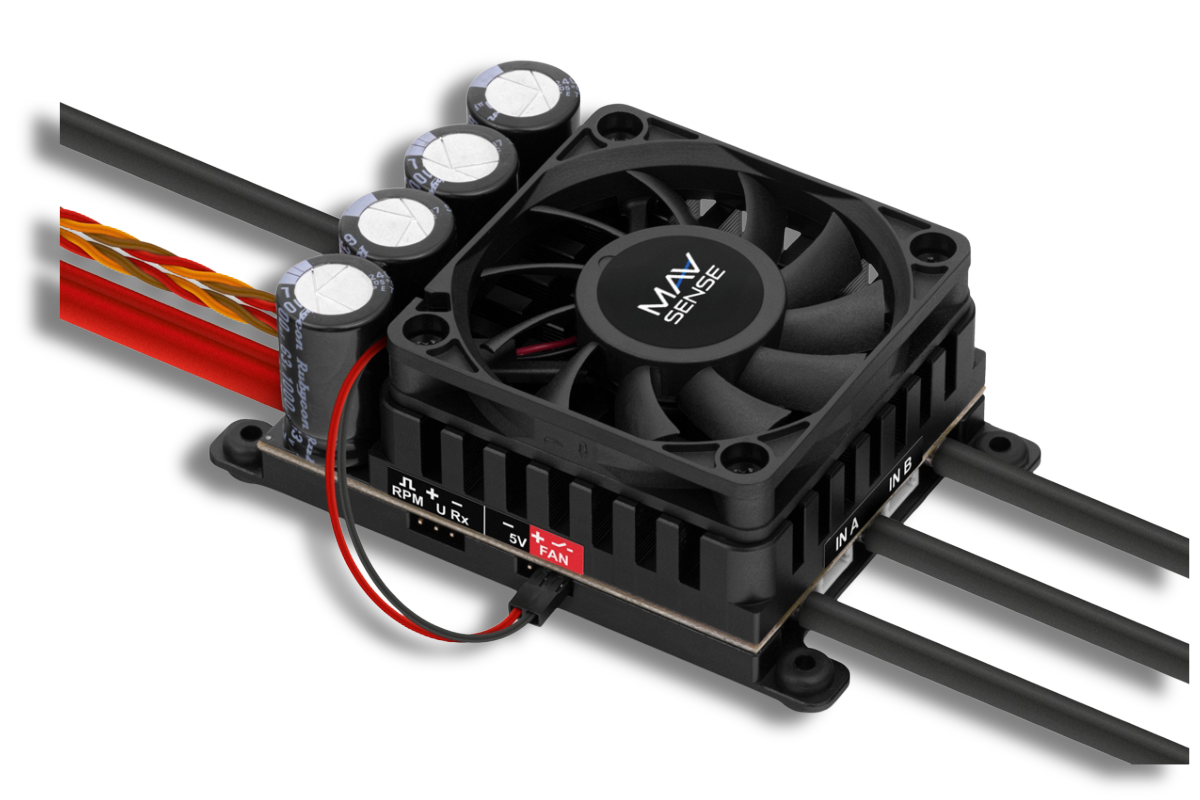
Electronic speed controller rated for 200 A continuous current. It provides galvanic isolation between power and logic circuits, an integrated fan output, and support for telemetry protocols. With protections against over-current, over-temperature, and voltage faults, it is well suited for UAV propulsion systems with medium to high power demand.
Product highlights
Max. Power
Max. Current
Voltage
Weight
Pairs well with
Verified EU-made.
Cyber security built into every component.
Remote troubleshooting & configuration help
Controller IBEX 200X
Product details
⚡ The IBEX 200X delivers up to 200 A continuous current at voltages up to 51 V (12S LiPo). It is built for high-power electric propulsion systems in UAVs, eVTOLs and large RC aircraft where absolute stability and performance are crucial.
🌡 The robust aluminum housing ensures superior cooling and long-term durability. Even under extreme electrical and thermal load, the ESC maintains reliable operation and extends component lifetime.
📊 Integrated telemetry provides real-time data such as voltage, current, capacity and ESC temperature. With support for external sensors, developers can closely monitor and optimize their system in every flight condition.
🛡 Safety features including overcurrent, undervoltage and thermal protection secure both the controller and the propulsion system. The opto-isolated design reduces interference and increases overall electrical safety.
⚙ Designed and manufactured in Europe, the IBEX 200X is a top choice for demanding projects requiring uncompromising reliability, efficient thermal management and precision control at very high power levels.
Basic parameters
Max continous current
Max continous power
Max peak current
Max peak power watt
Max voltage
Temperature range
Dimensions
Weight
Sensors & Control
Sensors
Control
Document
If you have any questions, you are always welcome to contact us. We'll get back to you as soon as possible, within 24 hours on weekdays.
-
Shipping Information
Use this text to answer questions in as much detail as possible for your customers.
-
Customer Support
Use this text to answer questions in as much detail as possible for your customers.
-
FAQ’s
Use this text to answer questions in as much detail as possible for your customers.
-
Contact Us
Use this text to answer questions in as much detail as possible for your customers.
FAQs
Please read our FAQs page to find out more.
What does an ESC do?
The ESC (Electronic Speed Controller) is the brain of the electric propulsion system. It regulates the current sent to the motor phases to achieve the required speed and torque. It also includes key protection features such as overcurrent, undervoltage, and overtemperature safeguards to prevent damage to the motor and power electronics.
How is the ESC controlled?
The ESC can be controlled by a flight controller, an autopilot, or directly by a transmitter or throttle signal. The most common control interfaces are PWM, CAN, and UART. PWM is simple and widely supported, while CAN and UART enable two-way communication for telemetry, configuration, and advanced diagnostics.
What happens if the ESC overheats?
Most ESCs monitor temperature via internal sensors. If protection is enabled, the ESC will reduce power or shut down. Without thermal protection, overheating can damage MOSFETs or capacitors and permanently destroy the controller.
How to prevent ESC overheating?
Provide adequate airflow or liquid cooling, depending on the ESC design. Avoid overloading the motor, since excessive current directly increases ESC temperature. Ensure correct propeller size or load and verify that wiring and connectors can handle the rated current.
What maintenance does an ESC require?
ESCs are maintenance-free. Keep them clean and dry. Use compressed air to remove dust, and check connectors periodically for corrosion or loose pins. Always make sure the ESC firmware is up to date.